
Many people use the terms Spiritism and Spiritualism as if they mean exactly the same thing. After all, both explore questions about the soul, life after death, and the possibility that reality extends beyond the physical world.
At first glance, the confusion is understandable. The two concepts share certain ideas and historical connections, and both gained visibility during periods when people were actively searching for answers about consciousness, death, and the spiritual dimension of existence.
However, despite these similarities, Spiritism and Spiritualism are not identical.
Understanding the difference between them is important for anyone interested in spirituality, philosophy, mediumship, or the broader question of what happens after death. While Spiritualism functions as a broad and diverse movement that embraces many perspectives, Spiritism emerged as a specific doctrine with its own principles, literature, and methodology.
This guide explores the origins, beliefs, and practices of both traditions to help clarify where they overlap and where they diverge.
What Is Spiritualism?
Spiritualism can be broadly defined as the belief that reality extends beyond the physical world and that human consciousness survives bodily death.
Unlike many organized religions, Spiritualism does not have a single founder, a universally accepted sacred text, or a central authority that determines what all spiritualists must believe.
This is one of its defining features.
Over time, different spiritualist groups and communities developed their own understandings of subjects such as:
- The nature of the soul
- Life after death
- Spirit communication
- Personal spiritual development
- The purpose of human existence
Because of this diversity, people who identify as spiritualists may hold very different beliefs from one another.
Some believe in reincarnation. Others do not.
Some actively practice mediumship, while others focus on meditation, healing, intuitive development, or personal spiritual exploration.
What unites these different approaches is a common recognition that there is more to reality than can be perceived through the physical senses alone.
For many spiritualists, personal experience plays a fundamental role. Rather than accepting spiritual truths solely through authority or tradition, Spiritualism often encourages individuals to explore spiritual questions through observation, reflection, intuition, and direct experience.
This flexibility has helped Spiritualism remain relevant across generations, adapting to changing cultural and intellectual environments while maintaining its core conviction that human beings are fundamentally spiritual in nature.
Today, Spiritualism attracts people from many different backgrounds who are interested in understanding consciousness, exploring spiritual dimensions of life, and seeking meaning beyond the material world.
The Historical Origins of Spiritualism
Although beliefs about spirits and an afterlife have existed throughout human history, modern Spiritualism became especially visible during the nineteenth century.
This was a time of major transformations.
Scientific discoveries were reshaping society. Industrialization was changing daily life. At the same time, many people were seeking answers to questions that science had not yet addressed.
Interest in psychic phenomena and spirit communication grew rapidly.
Reports of séances, mediumistic communications, and unusual spiritual experiences attracted public attention throughout Europe and North America. Newspapers, public lectures, and spiritual gatherings fueled widespread curiosity about what might exist beyond physical death.
As interest expanded, organizations dedicated to studying spiritual phenomena began to emerge. These groups explored mediumship, survival after death, psychic experiences, and the possibility of communication between the living and the deceased.
Unlike a centralized religion, however, Spiritualism developed as a network of related movements rather than a single institution.
Different communities adopted different beliefs and practices. Some focused heavily on mediumship. Others became more interested in healing, philosophy, metaphysics, or personal spiritual development.
This diversity remains one of the movement's defining characteristics today.
Regardless of their differences, most spiritualists share a common belief: human consciousness does not end when physical life ends.
What Is Spiritism?
While Spiritualism developed as a broad movement, Spiritism emerged as a specific philosophical and spiritual doctrine.
Spiritism was codified by Allan Kardec, the pen name of French educator Hippolyte Léon Denizard Rivail.
During the nineteenth century, Kardec became interested in reports of spirit communication and other phenomena that were generating considerable public interest throughout Europe.
Rather than accepting these claims blindly, he chose to investigate them systematically.
By collecting information from different mediums and comparing reports from multiple sources, Kardec sought patterns and consistency that could help explain fundamental questions about life, death, and human existence.
The result of his work became what is now known as Spiritism.
Spiritism is built upon several core principles:
- The existence of God as the intelligent cause of the universe.
- The immortality of the soul.
- Reincarnation.
- Communication between spirits and human beings.
- Moral and intellectual evolution.
According to Spiritist philosophy, physical life is only one stage within a much longer journey of spiritual growth.
Human beings are seen as immortal spirits temporarily inhabiting physical bodies while learning, evolving, and progressing toward greater wisdom and moral understanding.
Unlike Spiritualism in its broader sense, Spiritism possesses a clearly defined body of literature, a coherent philosophical structure, and a specific methodology for studying spiritual phenomena.
This organized framework is one of the primary reasons Spiritism is considered a distinct doctrine within the broader spiritual landscape.

The Historical Origins of Spiritism
Spiritism emerged in France during a period marked by scientific curiosity, philosophical debate, and widespread interest in unusual phenomena.
One of the most famous phenomena of the era involved the so-called “turning tables,” which appeared to move and respond to questions without visible physical intervention.
While many observers dismissed these events as entertainment or superstition, Allan Kardec chose to investigate them more thoroughly.
He collected reports, compared communications, and analyzed information obtained through different mediums.
Rather than focusing solely on the phenomena themselves, Kardec became interested in the ideas allegedly communicated through them.
His research ultimately led to the publication of The Spirits' Book, which became the foundational text of Spiritism.
Additional works later explored topics such as mediumship, morality, reincarnation, and spiritual evolution.
Over time, Spiritism spread beyond France and reached various countries, finding particularly strong reception in Brazil, where it continues to be one of the most influential spiritual movements today.
How Spiritism and Spiritualism View Mediumship
Mediumship occupies an important place in both Spiritism and Spiritualism.
However, each tradition often approaches it differently.
Within Spiritualism, mediumship is generally seen as a personal spiritual experience. Different groups may use mediumship for spirit communication, intuitive development, healing practices, psychic investigation, or personal spiritual growth.
Because Spiritualism encompasses many different traditions, there is no universal framework governing how mediumship should be practiced or interpreted.
Spiritism approaches mediumship in a more structured way.
It views mediumship as a natural human faculty that can be studied, developed, and exercised responsibly.
According to Spiritist teachings, mediumship should not be pursued primarily for entertainment, curiosity, or spectacle. Instead, it should contribute to learning, self-improvement, ethical development, and constructive spiritual communication.
This difference in perspective represents one of the clearest distinctions between the two traditions.
What About Reincarnation?
Few topics reveal the differences between Spiritism and Spiritualism as clearly as reincarnation.
In Spiritism, reincarnation is a fundamental principle.
It serves as the mechanism through which spiritual growth takes place.
Each lifetime provides opportunities to learn new lessons, develop virtues, overcome limitations, and continue evolving.
Within Spiritualism, however, there is no universally accepted position regarding reincarnation.
Some spiritualists embrace the concept completely.
Others reject it.
Still others consider it a possibility but remain uncertain.
Because Spiritualism lacks a single doctrine, beliefs about reincarnation vary considerably depending on the individual or community involved.
This difference highlights once again the contrast between a broad spiritual movement and a more structured philosophical system.
Spiritism vs. Spiritualism: The Main Difference
After examining each tradition independently, the distinction becomes much easier to understand.
Spiritualism is a broad spiritual movement encompassing many beliefs, practices, and perspectives concerning spiritual reality.
Spiritism is a specific doctrine with clearly defined principles, literature, and objectives.
A simple way to summarize the relationship is:
Every Spiritist is a Spiritualist, but not every Spiritualist is a Spiritist.
A person may believe in the soul, spiritual dimensions, life after death, and personal spiritual development without ever studying Allan Kardec's teachings.
A Spiritist, however, follows a particular philosophical and spiritual framework based on the principles of Spiritism.
Spiritism vs. Spiritualism: Key Differences at a Glance
| Aspect | Spiritism | Spiritualism |
|---|---|---|
| Origin | Codified by Allan Kardec | Developed through various spiritual traditions |
| Structure | Organized doctrine | Broad spiritual movement |
| Literature | Defined body of works | No universal texts |
| Reincarnation | Fundamental principle | Varies among practitioners |
| Mediumship | Systematically studied | Interpreted differently across groups |
| Primary focus | Moral and spiritual evolution | Spiritual exploration and experience |
Why Are These Concepts Often Confused?
The confusion is understandable.
Both traditions discuss spirits, consciousness, mediumship, spiritual experiences, and life after death.
Both gained significant visibility during the nineteenth century.
Both use language related to spirituality and the unseen dimensions of existence.
In everyday conversation, the terms Spiritism, Spiritualism, spirituality, and spiritual beliefs are often used interchangeably.
This creates the impression that they describe the same thing.
In reality, the distinction is more nuanced.
Spiritualism represents a broad spiritual landscape.
Spiritism occupies a specific place within that landscape.
Spiritualism Around the World
Today, Spiritualism exists in many forms throughout the world.
Modern spiritualist communities can be found in North America, Europe, Australia, and numerous other regions.
Different groups may emphasize different aspects of spiritual life, ranging from mediumship and healing to meditation, self-discovery, and consciousness research.
The movement's flexibility is one of the reasons it continues to attract individuals interested in exploring spiritual questions outside traditional religious frameworks.
Spiritism Around the World
Although Spiritism originated in France, it experienced remarkable growth in Latin America, particularly in Brazil.
Today, Spiritist organizations, study groups, educational institutions, and charitable projects operate in numerous countries.
Many Spiritist communities focus not only on studying philosophical principles but also on applying ethical teachings through volunteer work, social assistance, and educational initiatives.
This combination of spiritual study and practical service remains one of the movement's most distinctive characteristics.
Spiritism and Modern Spirituality
Modern spirituality encompasses a wide variety of beliefs and practices.
Meditation, mindfulness, holistic wellness, personal development, consciousness studies, and energy-based practices have become increasingly popular over the past several decades.
Many of these activities share themes that overlap with concepts found within Spiritualism and Spiritism.
Discussions about consciousness, personal growth, compassion, and human purpose often serve as common ground between these traditions and contemporary spiritual movements.
However, participating in modern spiritual practices does not automatically place a person within either Spiritism or Spiritualism.
Understanding these distinctions can help readers navigate the increasingly diverse world of modern spirituality.
Common Misconceptions About Spiritism and Spiritualism
Several misconceptions continue to generate confusion.
“Spiritism and Spiritualism are the same thing.”
They are related, but they are not identical.
“All spiritualists believe in reincarnation.”
Beliefs about reincarnation vary significantly among spiritualists.
“Spiritism is only a religion.”
Many followers also view it as a philosophy and a method for studying spiritual realities.
“Spiritualism lacks philosophical depth.”
Many spiritualist traditions have developed sophisticated ideas about consciousness, ethics, and human purpose.
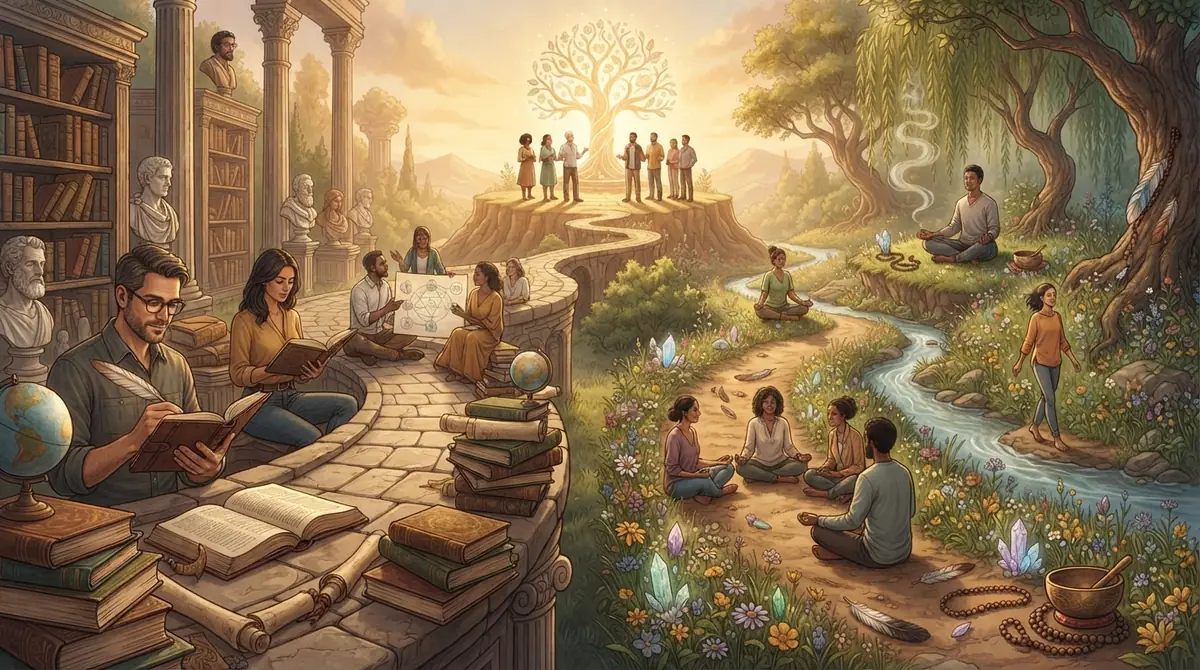
Why the Distinction Matters
Understanding the difference between Spiritism and Spiritualism involves more than learning terminology.
It helps readers better understand books, movements, authors, and spiritual traditions that address some of humanity's most profound questions.
Questions such as:
- What happens after death?
- Does consciousness survive bodily death?
- Is there a spiritual dimension to reality?
- Why are we here?
- Is human life part of a larger process of growth?
Both Spiritism and Spiritualism attempt to address these questions, but they do so from different perspectives.
Spiritualism offers a broad framework for spiritual exploration.
Spiritism provides a specific philosophical and spiritual doctrine with clearly defined principles.
Recognizing this distinction allows readers to navigate spiritual ideas with greater clarity and appreciate the unique contributions each tradition offers to the ongoing search for meaning, purpose, and understanding.
Frequently Asked Questions
Are Spiritism and Spiritualism the same thing?
They are related but not identical. Spiritualism is a broad movement with diverse beliefs, while Spiritism is a specific doctrine codified by Allan Kardec.
Do all spiritualists believe in reincarnation?
No. Beliefs about reincarnation vary among spiritualists. In Spiritism, reincarnation is a fundamental principle of spiritual growth.
How does Spiritism approach mediumship?
Spiritism views mediumship as a natural faculty that should be studied and practiced responsibly, with an emphasis on learning, ethical development, and constructive communication.
What is the main difference between Spiritism and Spiritualism?
The main difference is that Spiritualism is a broad spiritual movement, whereas Spiritism has defined principles, literature, and a structured philosophical framework.